
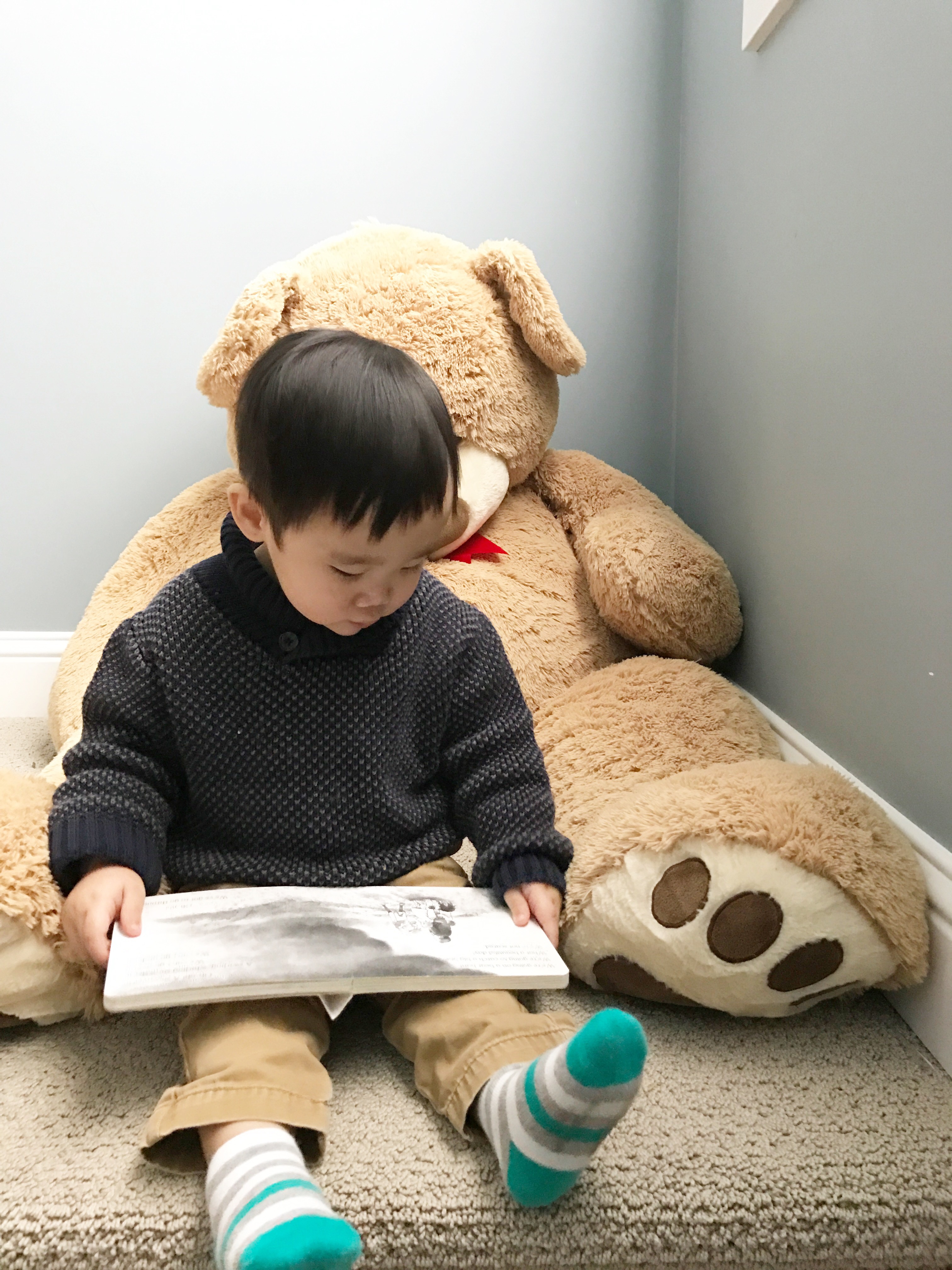
I don’t know about you and your babies, but Jordan wants to read the same book over, and over again. What? Your kids, too? Yep.
I can’t blame them. Them wanting the same book read over and over again, is like us being a regular at our favourite coffee shop or restaurant. You walk in, you know what to expect and how to behave, the staff knows you, you know them, they know your order, you have a good time! What’s not to like?
I’m not going to put on my teacher hat and tell you all the theoretical reasons why children like to reread the same book, or why we SHOULD reread the same books. I’m sure there are better websites out there, with more authority on this regard than I do, they can explain it all to you.
What I plan to do is share some of the things I do that keeps me from feeling like a running record, and also makes the rereading more fun with the little ones. You might already be doing them, but it’s always good to try again 🙂 .
1. Take turns reading the pages.
If you have read the book many many many times with your little ones, I’m sure you have noticed that he/she loves to chime in as you read. Why not give you little one a chance to try it on his/her own? You read one page, and have him/her read the next. Or as much as he/she can of the next page. Just give them a few more seconds to remember. You might be surprised.
2. If they are handling #1 well, let them read more of the story to you, and you play the supportive/backup role.
Depending on the book and the age of your child, he/she may even be ready to read the whole book (Or most of the book) to you. Start them off by reading the title AND the author (Knowing that someone wrote the book is important, too!) together, maybe even read the first page with him/her. After that, let them take the lead and allow them to show you what they can do!
3. You read most of the story, and invite your little one to read/talk as one or more of the characters.
If you are reading a story where the characters talk to each other (For example, “The Three Little Pigs”), invite your little one to play the role of one of the characters (5 bucks says they will want to be the wolf 😉 ) The next time you read the book, switch characters with each other.
4. Better yet, read and tell the story with props!
Don’t panic! Props can be as easy as a piece of paper with a picture of the characters. If you have puppets of the characters, that’s great. If not, it can take as short as 1 minute to make some. If you have post-it notes handy, draw the characters on them and stick them to your finger. Voila! For a little more, you can print pictures of the characters and glue them stir sticks or popsicle sticks (The next time you go to that coffee shop, grab a few more stir sticks *wink wink* 🙂 ). There are so many more ways to make simple, easy puppets for the characters in your story. Bonus: put these puppets in a ziplock bag with the story book and Tah-Dah! You’ve got yourself a little retelling story package to take ono the road!
5. Act out the story!
I know, I know. It’s 8 o’clock at night and the last thing you want to do is get up from that comfy bed of theirs to move and pretend to be Daddy Pig from Peppa Pig. Let’s give it a try! No Drama class teacher here judging your performance. Just your little one seeing Mommy and Daddy enjoying literatures and playing with him/her. Do yourself a favour and pick a short story to start with. It might take a little practice to do the entire Harry Potter story on your first go. Plus, you do want your little one to sleep at some point, right? You can be as low key as acting it out with no props (Imagination is the key! Just say “Oh and here’s that big cave we are about to go into!” and gesture a big cave in front of you. Don’t go and build one. Your significant other may not be happy.).
6. Create actions to go with the story.
Children’s book are full of patterns. Whenever you spot a pattern, make up some action to go with it. For example, when you read “Brown Bear, Brown Bear, What Do You See?” with your 18month-old, you can point to your eyes, and have him/her point as well, when you say “see”. Again, it doesn’t have to be complicated. You’ll be amazed how very simple things can make all the difference.
7. Read the story in a quieter/slower/quicker/squeakier/robotty-er voice.
Use a different voice. Try reading at a different speed or rhythm tonight. You can be silly and try reading “Moo, Baa, LaLaLa” in a squeaky voice! Obviously, you don’t want to be too too silly because you are probably wanting your little one to wind down for bed, but a little fun and snuggles would hopefully make bedtime routine smoother.
8. Try not reading the words this time.
What I mean is, try focusing on just the pictures tonight. Talk about the things that you see in the pictures. Talk about what the characters are wearing or how they are moving. Talk about what they might say, or what else they might say. This might be challenging for adults, too, being so use to reading the words in these stories.
9. Letter/Word hunt
This is for those of you with older little ones (maybe age 4 and up). If they are ready (for example, if you know that he/she knows a certain letter/word very well), then, before you start reading the story, say “Oh my goodness ( 🙂 come on, some drama here will make them want to do it with you! Lol) ! I noticed a letter E here (point to it…)! Let’s have a contest and see who can find the most E’s in this book! Ready?!”
Give it a whirl.
10. Let them choose!
Give them a few of these choices and see what they would pick! As long as you are sitting together, spending time together, and enjoying the time together, anything goes! Don’t forget hugs and kisses (or a high five!) before the lights go out!
Enjoy your read together.
Thanks for reading.
Chat soon,
Stephy
 stephyeverafter.com